ON WRITING, AVOIDANCE, AND SHOWING UP FOR EACH OTHER

Somewhere in the space between reluctance to commit and the sense of being too busy, I have found a million other things to do besides write to you.

But when I articulate for myself what this work is all about, I know: it is about being a conduit for God’s love. Which is unconditional, a form of grace, and has nothing to do with reluctance to commit, or being too busy, or the million ways in which we hide from one another and from Him. Her. It. Whichever pronouns suffice to point to that sense of Greater Than All Of This, Always. That’s what I mean when I say God. But theology is for another time. After all, this is my way of initiating (resurrecting?) “On My Mind,” which has lived on the website as the Rabbi’s Blog, and until now has been the landing spot for my sermons and teachings.

At first, it was a sense of priority: get to know several hundred families. That was the most important thing when I began two and a half years ago. I gave myself eighteen months. (If you’ve never taken me up on my open office hours, it’s still a thing. Click here to schedule time together.) As I prepared for the High Holidays last summer, I had a plan: beginning with the new Torah cycle, I would share Torah weekly—maybe a video, maybe written, maybe both. (Would that the sermon was still that forum; I do hope that one day we will get to that place, where coming together weekly on Shabbat mornings will feel compelling and holy to more of you. It does to some of us already, and those I get to see each week—and even each morning, some of us, at daily minyan online—get what I mean. But I’ve come to realize—not without sadness—that for the rest of you I’m going to have to reach out beyond that medium.) So yes, I thought, I’ll do what many of my rabbinic colleagues do, and not only write a weekly d’var torah for services, but also create something that goes out to everyone and anyone who wants to read and/or watch it.

So, B’reshit. In the beginning. Those opening words of Torah, the first parasha, that first weekly reading of the Torah cycle. That’s where I thought I  would start, when this idea germinated last summer. Get through the High Holy Days, Sukkot, and then as we begin the Torah over again I’d be off and running. 

We read it on the morning of October 8.

War. At that point, a terrorist attack and hostages taken and the Jewish people shattered to its core. Israel not yet striking back, not yet mobilized to retrieve those taken, still counting the missing and the dead and unsure who was which. Those first weeks-turned-into-months tipping us over the edge from the comfort zone we’d been in to a discomfort zone of anxiety, fear, sadness, uncertainty, worry, grief, despair. The writing I’ve managed to send out since then has centered around all of this. Too much else to do, holding so many people with hurting hearts. Good thing we spent those eighteen months getting to know each other. 

But now it’s time to expand out. To go ahead and nourish us with Torah of all sorts. I’m not sure exactly what it will look like. Sometimes, it will be the weekly Torah reading; other times, it will be movies, or what’s on my mind with the kids or life in general. I don’t know yet. What I do know is that we need more Torah, more teaching, more wisdom, more spiritual succor. We crave it, now that the shock has taken root in our bones, the shock of this war and the resurgence of anti-Semitism; the shock of the culture of this country in this election cycle and culture-shift—but also the shocks and aftershocks to this congregation of a generational shift in leadership. 

Two and a half years into my tenure as your rabbi, there are still a million things that keep me from reaching out in this way. But if I push myself to articulate why I want to write to you at all, it is this:. Because I want to be in relationship with you. And in order to do that, we have to show up for one another.

So this is me trying a new way of showing up. In return, I hope you’ll try new ways, too. Because I love you, and God loves you, whatever that might mean to you. And if you don’t know, or are surprised to hear a rabbi saying those words which have come to sound Christian or just empty—well, good. That gives us something to talk about over our next cup of coffee, our next email exchange, the next time you push yourself to show up in this relationship with me, with Oheb, and with the Jewish people.

“Our task here in Maplewood and South Orange…”

As published in TAPInto SOMA.

Last week’s public statement condemning the removal of the Israeli flag from the exterior of one of our town’s synagogues was one visible example of the often unseen work of our elected officials do on behalf of our community.

In another era, it would have been unremarkable for town officials to write a public letter condemning vandalism that many members of the Jewish community experienced as an act of intimidation or hate, regardless of what investigators ultimately determine about the motive.

There were several decades in American life in which it would have been no big deal for elected officials – especially in politically progressive towns – to name their support for the Jewish community, to publicly state that they are “united in condemning the disturbing removal of the Israeli flag” from the exterior of one of the town’s synagogues, and to condemn antisemitism.

But in 2026, such statements are, sadly, remarkable. They are a very big deal and are deeply appreciated by the Jewish community and, I hope, the broader communities of South Orange and Maplewood as a whole. 

Increasingly, public officials choose language that condemns hate in general while avoiding naming Jews specifically, particularly when the incident involves Israel. Naming a community that has been targeted, expressing the understanding that the flag taken down is a “symbol of Jewish faith and identity” does not diminish anyone else’s suffering. It tells the community that it has been seen, and is valued and supported.

Loud voices are pulling us toward division in our beautifully diverse community. Some wish for stronger public responses. Much of the work elected officials and law enforcement do, however, necessarily happens outside public view. Others see the conflict in the Middle East as their primary lens. But local government has a different responsibility, and so do we as friends and neighbors.

Our task here in Maplewood and South Orange is not to resolve the Middle East crisis. Our task is to decide how we treat one another as neighbors here, in this little corner of New Jersey. 

How grateful we all should be that our elected officials care enough about each of us to do the work—seen and unseen—to make South Orange and Maplewood a place where not only hate has no home, but where shared values of tolerance, peace, and relishing differences are a source of strength, pride, and celebration.

The Unmarked White Van

I didn’t mean to freak out. Especially just a day after I’d sent out a message encouraging us all to keep calm.

Nonetheless, when an unmarked white van pulled up in front of my home a few days ago, I noticed my heart beat a little faster. From an upstairs window I watched the driver place a package at our doorstep, and then run back to the van. It’s possible I tried to catch the license plate number. It’s possible my mind raced to the worst: why would he be running back to the van, unless…? Good thing I meditate enough to be able to notice the thoughts as they come (sometimes, anyway) and then give my imagination a solid round of applause for another terrific performance.

I guess we’re all pretty jacked up. I mean, it’s hard not to be. Two thousand years of intergenerational trauma and that’s not counting the slavery in Egypt part. It’s in the DNA, biologically and figuratively speaking.

Two thousand years ago (1,956 to be precise), the locus of our religion and people was destroyed, Jerusalem burned, and the Jews evicted. Thus began the Diaspora, bringing us as a people to the four corners of the earth and beyond, since it turned out the world was round; perhaps that’s part of why we ended up back in that same Promised Land just a generation later, even if we wouldn’t be able to govern there again until 1948. Unclear how that part of the story will go, and what its next chapter will be.

What is clear is this: that this Wednesday night, Jews all around the world will gather to read the one Biblical book devoted entirely to mourning the destruction of the Temple. It is the start of a fast day, Tisha b’Av, the 9th of the month of Av, the national day of grief and mourning for the Jewish people. The only other full, 25-hour fast day in the entire calendar is Yom Kippur. On Yom Kippur, we atone – together as a people – for our individual shortcomings. On Tisha b’Av, we sit together and let the fear, the sadness, the pain of the Jewish people from generation to generation be with us in the room.

What a genius move. With the Temple gone, Judaism could have and logically should have been extinguished along with the flames of the fires set that day in 70 CE. The Torah contains an invincible weapon, though: the calendar. The rabbis added this day of commemoration to the holiday cycle given to us in the Torah, and they placed it so that it would help us in every generation turn back to our people and our roots.

Tisha b’Av always falls seven weeks before Rosh Hashanah: seven weeks of consolation, these weeks are called, and on Day 50 – we gather again, in our finest clothing, tables laden (please God) with food, and we blow the shofar to celebrate the New Year for the Jewish people.

Because no matter how afraid we may feel, no matter how anxious we get in our kishkes about the package arriving on the doorstep or the stranger walking into shul; no matter how angry we grow over the normalization of anti-semitism or how bewildered we feel by friends and neighbors we once considered trustworthy allies… the Torah’s got us.

Not because Torah promises that nothing bad will happen. Lots of bad things happen to the Jewish people (and by them, too) in the Torah and throughout Tanakh, the Bible.  What Torah gives us is the promise that we will never have to face whatever comes without a way to make meaning of it, without practices to steady us, and most importantly, without each other.

So these days leading up to Tisha b’Av, we are allowed to freak out a bit. And then, after a gathering and a fast, let’s let the calendar do what it has done for nearly two thousand years. Let it carry us toward consolation, toward hope, toward the sound of the shofar calling us back from the ancient source of our people. 

An unmarked white van, a flag torn from our shul in the middle of the night, and so much else sets off in us fear, anger, and a host of other emotions. All of it is part of being human; all of it is part of the Jewish story. Torah carried our people through the destruction of the Temple, through exile, and through every generation since. It will carry us through this moment too, and through all the other freak-out moments large and small along the way.

If you’re wondering, it was the opposite of scary: an item I’d purchased from Nordstrom’s, delivered to my home when they were out of stock in my size in the store. A blessing on every level. No reason to freak out, only to give thanks.

Rabbi Abigail Treu

P.S. Oheb Shalom comes together with our neighboring synagogues for Tisha b’Av services this Wednesday night, July 22 at 8 pm.

P.P.S. On Thursday, July 23 at 6 pm, join me at Oheb Shalom as we remount the yellow star required by the Nazis to be worn by all Jews; it was removed for the renovations to Founders’ Hall last year and will be put up as part of the history display next to the Holocaust Torah from the Czech Republic.

For These Things Do I Weep


As Americans, we remember certain indelible dates such as December 7, 1941, when Pearl Harbor was attacked, or November 22, 1963, when President John F. Kennedy was assassinated.

We Jews also have such a date that holds tragic significance. The ninth day of the Jewish month of Av, known as Tisha B’Av, which occurs in mid-summer, holds major significance for the Jewish people.

On this date — or close to it — the following cataclysmic events occurred (descriptions of the events are greatly simplified):

1313 BCE: the spies sent out by Moses, as recorded in the Torah, returned with a negative report of the Promised Land.

586 BCE: The First Temple in Jerusalem was destroyed by the Babylonians, sending most Jews into exile.

70 CE: the Romans destroyed the Second Temple, carting off Temple treasures to Rome.

133 CE: the revolt against the Romans led by Simon Bar Kochba was put down with the destruction of the city of Betar, resulting in a name change to the land and the end of an independent Jewish state.

1095 CE: the First Crusade began, bringing with it attacks on Jewish communities in Europe.

1290 CE: Jews were expelled from England. They were not legally accepted back until 1656 under Oliver Cromwell. This is the first instance of the entire Jewish population being banished from a country.

1492 CE: Spanish Jews were forced out of Spain. They were not allowed back in until 1868, when a new constitution supported freedom of religion. However, the original Alhambra Decree of 1492 was not rescinded until 1968.

1914 CE: World War I began.

1941 CE: The Final Solution received official Nazi Party approval.

1942 CE: Treblinka began operating, and deportations from the Warsaw Ghetto started.

1994 CE: the Jewish Community Center in Buenos Aires was bombed, killing scores of people and injuring at least 300.

For these things do I weep; for the foe has prevailed.
Gone is the joy of our hearts; our dancing is turned into mourning.
(from the Book of Lamentations)

There are few standalone resources for Tisha B’Av beyond a chapter here and there in holiday anthologies and the text of Lamentations.

For more information:

Sefaria for the text of Lamentations.
Wikipedia for basic information.
My Jewish Learning: https://www.myjewishlearning.com/article/tisha-bav-101/
American Jewish World Service: https://ajws.org/who-we-are/resources/holiday-resources/tisha-bav/

P.S. In Founder’s Hall, there is a Torah scroll that survived the Holocaust and came to us with a story of its lost community in the Czech Republic. For many years, it has been flanked by a yellow star worn by Jews under Nazi occupation and documents attesting to both artifacts’ history. Taken down during last year’s renovation of Founder’s Hall, it is now time to put both back up, with a bit of solemn fanfare as befits their status as important artifacts of our people’s history. Join us on Thursday, July 23, starting at 6 pm.

Message to the Oheb Community

Surprise, and no surprise: the Israeli flag was taken down from our building by vandals at some point this past weekend. It was up over Shabbat, and when I stopped by this evening after a weekend away, I saw that it had been torn down. It looks like someone cut it off the building. What does it say that they left the American flag and the Pride banners intact? The message is loud and clear.

First and foremost, know that the South Orange police are investigating, and all the protocols we have carefully put in place are now under way. If and when there is more information to share, we will share it. Know that our President Doug Magid is in close touch with the staff and leadership, monitoring the situation for the safety of all. Before we jump to conclusions or make accusations, let’s give the investigation time to fact find.

Pavel and I were away this weekend in the Berkshires. Walking around the sweet New England towns, I was struck—as I always am—by the wide-open doors of the churches. The main streets lined with churches of various denominations, doors propped wide open to the summer breeze and to welcome all passersby. Not a single guard or police officer in sight. Just… people going to church, for spiritual uplift and to be with other big-hearted people in their community.

I found myself thinking about the impact of our vigilance. We, the Jewish people, seem to be constantly on the verge of panic. We have security committees (thank you to those who serve), board members trained for emergencies (thank you, too), guards at the door for services, school, and communal gatherings. The staff keeps the doors locked. In fact, the doors are always locked. I can’t imagine ever leaving them wide open to the summer breeze and anyone who wants to wander in.

This makes me really sad and really curious about what it does to our spiritual lives and parasympathetic nervous systems. Being on high alert isn’t good for us as a baseline state.

So let’s choose not to be.

Let’s choose to take a deep breath and to be grateful — so very deeply grateful — for the law enforcement, staff, and volunteers working on this. And everyone else: just show up, as a proud Jew, or spouse or parent of a Jew. This Shabbat we welcome a church group, one so Zionist that they have Israel as part of their name. They wanted to experience Jewish worship services with us. Come join us.

Light Shabbat candles this Friday night and post it for everyone in your universe to see. Take a deep breath in, giving thanks for this community, this circle of love and support. Then exhale, and choose to let the worry go, dissolving it instead into a vision of what Oheb Shalom is at its core: a place of love and of peace, for Jews and for everyone who loves us. There are so many good and kind neighbors surrounding us. We do so much as a beloved part of this community, and while the loudest voices may frighten us, it is the quiet 99% that matter. We may not be able to fling our doors wide open to the summer breeze, but we can fling our hearts wide open—to one another, to our neighbors, and to everyone who comes seeking love and peace.

Our Story: (More Than) 250 Years in North America


The 250th birthday of our country is just a few days away. Such a momentous commemoration deserves notice. The United States, despite weathering significant challenges over the years, is one of the most enduring and successful attempts at democracy that people have created. And Jews have been here since the beginning.

What follows is a sampling of books that look back at not only the totality of American Jewish history but also at specific time periods, people, and unique events.

Some of these items are available in our library; others (marked BCCLS) are available through the Bergen County Cooperative Library System to which many of you have access.

An excellent additional resource is The American Jewish Archives. Founded in 1947 at Hebrew Union College in Cincinnati, it is the largest free-standing repository of material about American Jews. Its publication, The American Jewish Journal, is available in a searchable database.

Further reading about the United States can be found in the 973 and Biography sections and by checking the online catalog, which will lead you to many more items, including books for children and young adults.

Books are in order by publication date to show how opinions may have changed and how different topics come to the forefront.

Remember, it’s people who both make history and also interpret it.

Libo, Kenneth. We Lived There, Too.: in their own words and pictures. Pioneer Jews and the Westward Movement of America, 1630-1930. (1984)

Brodkin, Karen. How Jews Became White Folks. (1998) (BCCLS)

Porwancher, Andrew. The Jewish World of Alexander Hamilton. (2001) (BCCLS)

Sarna, Jonathan, with Pamela Nadell. Women and American Judaism: Historical Perspectives. (2001) (BCCLS)

Diner, Hasia. The Jews of the United States, 1604-2000. (2004)

Sarna, Jonathan. American Judaism: A History. (2004)

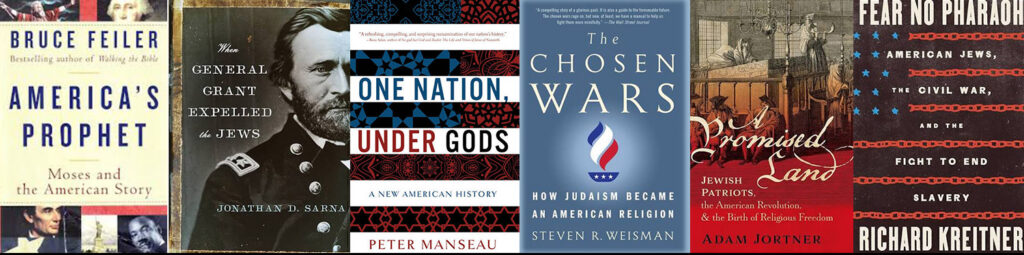
Feiler, Bruce. America’s Prophet: Moses and the American Story. (2009)

Gurock, Jeffrey. Orthodox Jews in America. (2009) (BCCLS)

Sarna, Jonathan. When General Grant Expelled the Jews. (2012)

Ashton, Dianne. Hanukkah in America. (2013) (BCCLS)

Goldman, Eric. The American Jewish Story through Cinema. (2013)

Manseau, Peter. One Nation, Under God: A New American History. (2015)

Sarna, Jonathan. Lincoln and the Jews. (2015) (BCCLS)

Rabin, Shari. Jews on the Frontier: Religion and Mobility in Nineteenth-Century America (2017) (BCCLS)

Fermaglich, Kirsten. A Rosenberg by Any Other Name: a history of Jewish name changing in America. (2018) (BCCLS)

Haynes, Bruce. The Soul of Judaism: Jews of African descent in America. (2018) (BCCLS)

Weisman, Steven R. The Chosen Wars: how Judaism became an American religion. (2018)

Wertheimer, Jack. The New American Judaism: how Jews practice their religion today. (2018)

Nadell, Pamela. America’s Jewish Women: A History from Colonial Times to Today. (2019)

Tamkin, Emily. Bad Jews: a history of American Jewish politics and identity. (2022)

Jortner, Adam, A Promised Land: Jewish patriots, the American Revolution, and the Birth of Religious Freedom. (2024)

Seligman, Scott. The Great Kosher Meat War of 1902: immigrant housewives and the riots that shook New York. (2023) (BCCLS)

Kreitner, Richard. Fear No Pharaoh: American Jews, the Civil War, and the Fight to End Slavery. (2025)

Porwancher, Andrew. American Maccabee: Theodore Roosevelt and the Jews. (2025) (BCCLS)

Rabin, Shari. The Jewish South: An American History. (2025) (BCCLS)

Seligman, Bruce. The Great Christmas Boycott of 1906: Antisemitism and the Battle over Christianity in the Public Schools. (2025)

The American Experience in Books

As we near the end of Jewish American Heritage Month, I’d like to share with you a variety of books about the Jewish American experience. The books cover many genres and subjects.

The Jacobs Library’s collection has many fine books about Jews and the Jewish experience in the United States, going back to New Amsterdam, where Jews insisted that they be included in the civic responsibilities of the community.

In addition, Jews fought in every war that the US was involved in, serving at a much higher rate than their percentage of the population.

So, come into the library, search the catalog for United States, or browse the 970 section for history.

For those interested in women in the United States, the Jewish Women’s Archive is invaluable (www.jwa.org). For more general information, the American Jewish Historical Society (www.ajhs.org) and the American Jewish Archives (www.americanjewisharchives.org) have extensive resources.

Many books for younger readers include more detailed and sophisticated background material. In my opinion, books for kids are for all of us, especially if the topic is new to the reader. And who doesn’t like a good picture? A picture is worth a thousand words.

Here’s a baker’s dozen (plus one) of books to tempt you.

NON-FICTION

Jortner, Adam. A Promised land: Jewish patriots, the American Revolution, and the birth of religious freedom. Early American history and policies set the stage for later reforms in Jewish religious and cultural life.

Kreitner, Richard. Fear No Pharaoh: American Jews, the Civil War, and the Fight to End Slavery. Should Jews support slavery and own slaves? This book looks at the question through the lives of six 19th-century immigrants.

Lambert and Stavans (editors). How Yiddish Changed America and How America Changed Yiddish.
Is it possible to conceive of the American diet without bagels? Or Star Trek without Mr. Spock? Are the creatures in Maurice Sendak’s Where the Wild Things Are based on Holocaust survivors? And how has Yiddish, a language without a country, influenced Hollywood?

Leifer, Joshua. Tablets Shattered: The End of an American Jewish Century and the Future of Jewish Life. A strong critique of modern American Jewish life whose 20th-century “pillars” of Americanism, Zionism, and liberalism are toppling.

Tamkin, Emily. Bad Jews: a history of American Jewish politics and identities. A wide-ranging look at Jewish American history, focusing on the 20th and 21st centuries. Thought-provoking.

FICTION

Arad, Maya. The Hebrew Teacher: Three Novellas. Three Israeli women living in the US navigate a culture that challenges them.

Lamb, Sacha. When the Angels Left the Old Country. A folklorish take on the standard immigrant tale with a demon and an angel as protagonists and the power of friendship as a major theme.

McBride, James. The Heaven and Earth Grocery Store. A history-mystery about a Pennsylvania neighborhood where poor Blacks and immigrant Jews lived. But it’s more than a who-dun-it. This is a story of community and friendship, beautifully written by McBride.

BIOGRAPHY

Eisner, Jane. Carole King: she made the earth move. Born Carol Joan Klein, the famously private sing/songwriter, made a huge impact on popular music in the 1970s. A recent  Broadway musical introduced King to a new generation. Part of the Yale Lives series.

Shnayerson, Michael. Bugsy Siegel: the dark side of the American dream. Part of the acclaimed  Yale Jewish Lives biography series, tells the story of one of the 20th century’s most notorious gangsters who made Las Vegas what it is today.

FOR YOUNGER READERS

Koffsky, Ann. The Peddler and the President. The dramatic story of how President Truman was persuaded to support the recognition of the State of Israel.

Rose, Lisa. The Singer and the Scientist. In 1937, contralto Marian Anderson had no place to stay after a concert in Princeton,  NJ, because she was Black. Famed physicist Albert  Einstein stepped in and offered her a place to sleep in his home. They shared music and the experience of being outsiders in American society.

Sharkan, Danielle. Sharing Shalom. When Laila’s synagogue is vandalized, the greater community comes together to help.

Yolen, Jane. Rebecca’s Prayer for President Lincoln. The community had gathered in the synagogue for Shabbat services when the rabbi interrupted the prayers and announced that President Lincoln had been assassinated. The congregation then spontaneously recited the Mourner’s Kaddish. A moving tale told through the eyes of a young girl. Based on a real incident.

Jewish American Heritage Month: Short Stories


We’re not in Camelot, but it is the “lusty Month of May.” May plays host to Jewish American Heritage Month, Short Story Month, Children’s Book Week, and a plethora of other special celebrations.

To mark the confluence of Jewish American Heritage Month and Short Story Month, I am featuring some of the short story collections, of which there are many.

Don’t ever think that short stories are lesser bits of literature than novels. In a short story, as in a children’s picture book, every word counts, although the picture book has the advantage of illustration to expand the text. There is no room for rambling or for elaborate descriptions in a short story. The writer must choose the right word, not words, or that short story will no longer be short.

Short stories can contain every emotion that a longer work does and can elicit the same reactions; it just does it with fewer words. Short stories can be easily read in one sitting, but a good collection will entice the reader onto the next story and the next.

Here is a small sample of some of the recent and classic short stories in our library. They are all listed as fiction and are shelved alphabetically by author and occasionally by title.

America and I: short stories of American Jewish women writers. There are twenty-three stories written in the 20th century by some of the best writers of American fiction.

Because God Loves Stories: an anthology of Jewish storytelling. This anthology collects stories from many times and places but includes some American stories.

Oxford Book of Jewish Stories. There are 52 stories from around the world, with a noteworthy selection by American authors.

Englander, Nathan.  What We Talk About When We Talk About Anne Frank. These stories from the noted novelist have been called “bizarre, surreal, hilarious.”

Gold, Nora, Editor. 18:  Jewish stories translated from 18 languages. While not American stories, this collection shows the wide range of short stories from many different countries.

Grynberg, Mikoceaj. I’d Like to  Say I’m Sorry, But There’s No One to Say Sorry To. These darkly funny stories set in contemporary Poland are translated from Polish. This book was a finalist for the National Jewish Book Awards.

Howe,, Irving. A Treasury of Yiddish Stories. “Fifty-two Yiddish short stories describe life in the shtetl and other aspects of the Jewish experience, and include works produced by Jewish writers during the last two centuries.” Some stories are set in the United States. A classic collection

Keret, Etgar. Fly Already. Etgar is a laudatory story writer whose work transcends nationality.

Moses, Jennifer. The Man Who Loved His Wife. A collection of stories with a modern sensibility.

Tsabari, Ayelet.  The Best Place on Earth. Winner of the Sami Rohr Prize. While these stories don’t take place in the U.S. (some are set in Canada), Tsabari is one of the best contemporary writers and is well worth reading.

jewishfiction.net is a website that features short stories from around the world. Some are available gratis, but there is a charge to have full access to the site. But if you love short stories, it may be worth it.

Why Was This Seder Different from All Other Seders?

Some of you may remember when I wrote about celebrating the ninth night of Hanukkah to accommodate my family’s arrival in Montclair.

A nearly identical situation-but in reverse- occurred this Passover. My granddaughter came down from Canada, where she is in college, but had to go back before the official start of Passover, thus missing the seder. What’s a grandmother to do but be flexible?

So we celebrated Passover on the Shabbat before Passover and called it the crazy mixed-up seder. The table was filled with our Passover artifacts- a hand-embroidered matzah cover, Rebecca’s 40-year-old pillow from religious school (do children make Passover pillows anymore in religious school?), the good china and silver.

And because it wasn’t yet actually Passover, we had both unleavened and leavened bread because everyone wanted to taste Liv Bread’s hallah.

Every year I try to give a new twist to our haggadah. This year, I used the haggadah from the Jewish Grandparent’s Network (jewishgrandparentsnetwork.org) This website has lots of resources for grandparents and parents and also hosts some excellent webinars.

My family wants not too much talking and reciting, but I find if the readings are good, the questions and conversation follow. I promised a 15-minute seder, but by the time we finished and embellished, it was more like 45 minutes. In my mind, that’s a good compromise.

The matzah balls tasted like my mother’s, the gefilte fish was-well- gefilte fish, the brisket was gobbled up, the chicken flew off the platter, and the matzah crack was addictive.

I tend to follow rules but Judaism is a practical religion: over the years we have changed to reflect culture and lifestyles while remaining true to the spirit of the law.

Like the ninth night of Hanukkah, our crazy, mixed-up seder celebrated our family, recalled old memories and made new ones.

To celebrate the end of Passover, you might want to incorporate some the traditions of the Mimouna holiday from Morocco. There’s delicious food and a spirit of community. For reference, read the charming children’s book by Allison Ofanansky, A Sweet Meeting on Mimouna Night.

In the upcoming weeks, look for lots of new books, including many for young readers on holidays and biographies of interesting people. All the awards are in and I’ll be purchasing the best of the best.

Finally, for your seder next year (or a later seder this weekend like a friend of mine is having) or any holiday, here are three recipes: easy, tasty brisket, an almost as easy chicken recipe and a luscious codfish dish. Quinoa goes nicely with all these entrees.

I like the following recipe because the ingredients are easy to find. Once it’s in the crockpot, it’s hands off and doesn’t take up oven space. It’s really tasty and also is easy to double. You can also make this brisket ahead of time and freeze.

Crockpot Sweet and Sour Brisket serves 4 or more, depending on menu

Ingredients

3 pounds of brisket, preferably 2nd cut
2 tablespoons neutral oil
2 large onions, diced
6 carrots, cut into matchsticks or small chunks
5 stalks of celery, chopped, plus leaves if you have them
6 cloves of garlic, chopped
1/4 cup dried cranberries
6 tablespoons cider vinegar
1/4 cup brown sugar
1/2 cup ketchup
3/4 cup stock
3/4 cup red wine
A handful of fresh herbs such as parsley and tarragon

Directions

1. Heat a large skillet and add 1 Tbsp. oil. Sprinkle all sides of brisket with a couple of pinches of salt and pepper. Add brisket to pan and brown on both sides (about 5 minutes a side). When brown, add to crock pot.

2. In same skillet, add a little more oil and sauté onions, celery, carrots and garlic for 5-10 minutes until slightly softened.

3. In a measuring cup add wine, brown sugar, stock, ketchup and vinegar. Whisk and set aside.

4. When vegetables are done, add cranberries and cook another minute. Pour in wine mixture; add herbs; bring to a boil.

5. Carefully pour vegetables and sauce over brisket in crock pot; cook on high 4-6 hours or on low 8-10 hours. Temperature should be 195-205 degrees and a probe should slide easily into meat.

6. The easiest way to slice is to cool completely and then reheat before serving. Don’t be tempted to slice hot meat. It will most likely shred rather than slice. Always slice across the grain.

7. Serve with some of the vegetables and sauce. To thicken sauce, add a small amount of potato flakes and stir until slightly thickened.

This chicken recipe, adapted from one by Shannon Sarna, couldn’t be simpler and it’s good for all year round. Definitely add the chick peas if you eat kitniot during Passover. Spatchcocking, also called butterflying, a chicken is pretty simply.It basically involves removing the backbone and pressing the chicken flat.  But a very sharp knife, a cleaver or good kitchen scissors are a necessity.  If you have never prepared a chicken this way, do try it. There are numerous tutorials on the internet. The chicken cooks faster and more evenly and looks nice on the platter. Double the marinade for a large chicken or several thighs

Harissa Honey Roast Chicken serves 4-8 depending on size of chicken

Ingredients

1 whole chicken, left whole or spatchcocked,  or chicken thighs
2 Tablespoons honey
2 Tablespoons prepared harissa, either mild or spicy
zest and juice of one lemon
1 Tablespoon olive oil
1/4 teaspoon salt
1/4 teaspoon black pepper
can or two of chick peas, rinsed and drained

Directions

1. Mix together honey, harissa, lemon zest and juice, olive oil, salt, and pepper.

2. Place chicken in a sealable heavy plastic bag. Add marinade. Massage chicken until fully coated. Add juiced lemon halves.

3. Refrigerate for 1 hour up 24 hours.

4. Preheat oven to 450 degrees. (375 for thighs)

5. Place chicken on a baking sheet or, if left whole, on an upright roaster.

6. Cook for 55-60 minutes or until a meat thermometer reads 165 degrees.(35-40 minutes for thighs)

7. If using chick peas, add to pan during last 15 minutes of roasting.

8. Cool slightly, cut into pieces, and serve.

Lastly, for a change of pace from the ubiquitous salmon, try this healthy recipe adapted from the New York Times for the pescatarians at your table.

Cod with Caper-Orange Sauce serves 4 as written

Ingredients

4 Tablespoons olive oil, divided
2 garlic cloves, thinly sliced
Grated rind of an orange, plus 1/4 cup orange juice
1 1/2 teaspoons white vinegar
1 teaspoon honey
1/4 teaspoon ground turmeric
Fine sea salt
2 tablespoons non-pareil capers, chopped, plus whole capers for garnish
8 cups/11 ounces packed spinach leaves, or baby kale or chopped stemmed collard greens
4 (5-7 ounce) skinless cod fillets or other white fish or about 1.5 pounds
1 tablespoon butter

Directions

1. Gather all ingredients.

2. Make sauce: In a medium bowl, add 3 tablespoons olive oil, the garlic, orange zest, orange juice, vinegar, honey, turmeric, and 1/2 teaspoon salt. Whisk until emulsified. Then add chopped capers. Set aside.

3. Heat the remaining tablespoon of olive oil in a large frying pan over medium heat for 1-2 minutes. Add spinach and cook, tossing frequently until just wilted, 3-4 minutes and cover to keep warm.

4. Pat fish dry and season lightly with salt.

5. In the same pan over medium heat, pour the caper-orange sauce and bring to a simmer. Add butter and keep stirring until it has melted.

6. Add cod and cook on one side 2-4 minutes, depending on the thickness of the fillets, and continue cooking until fish is cooked through and flakes easily with a fork. Alternatively, put cod on a sheet pan and roast at 400 degrees for about 12 minutes until cooked through and flaky.

7. Drain spinach and spread on platter. Place fish on top and spoon warm sauce over fish. Garnish with extra capers and serve immediately.

Note: Double sauce if desired.

Opening the Door for Elijah

I just ate my third slice of a cake that ended up on our counter despite my protestations that I’m off sugar. Which I am, or was, a little regimen I adopted from Purim until Pesach (Passover), or at least that was the idea, until the cake appeared on my counter. It was a gift. What’s a girl to do?

I share this because discipline and indulgence are themes of Pesach, the first cousins of slavery and freedom. We have all of them mixed up inside: the drive for a fiery discipline, for some internal or external voice keeping us on track and within bounds; and also, the yearning for liberty, that second piece of cake (or third) no matter what the disciplinarian has instructed. Rebellion is one sixtieth of liberty (in the way the Talmud says that a dream is one sixtieth prophecy, or maybe just the way the chicken soup is still kosher if the milk that accidentally fell into it was less than one sixtieth of the broth. Ratios matter, it seems, as does effort and careful consideration of what’s what.)

How do we make our way from servitude to liberation? This is the question Pesach asks of us, and the answers are multidimensional. The Torah calls Pesach chag ha-aviv, the holiday of spring: liberation from the bounds of winter as the earth turns, a matter of the natural course of things. Do nothing and it comes anyway, though you will enjoy it a whole lot more if you planted those tulips last fall. The Torah also gives us our foundational story, the covenant in which God chooses us for this particular way of being in relationship with one another and with the Divine, and we say yes. Far from natural: this is a willed, conscious choice, one that requires gathering with family and friends to tell the story and participate in rituals handed down for 3,000 years. The first Pesach was celebrated after Joshua led our ancestors into the Land of Israel in about 1400 BCE. And then there’s the rest of the week, the seven days (eight outside of Israel) that are ours, where the only real instruction is about how we eat. No chametz, nothing leavened. Here our liberation comes down to that third piece of cake: choice and discipline about what we eat, how quickly we give away our heritage in our rush for a slice of pizza, how interested we are in exploring a kind of freedom that comes with discipline. Liberation is not a one-shot deal. 

Heading into the seder night this year, I find myself thinking a lot about Eliyahu HaNavi, Elijah the Prophet. You know, the one we sing to, open the door for, pour that cup of wine for, the one we don’t drink but hope he does. Elijah makes his appearance in the Biblical Book of Kings, where he is full of anger and wrath and gets his way a lot on behalf of God and also overdoes it. He is the only prophet fired for having too much zeal. He exits the world stage in a chariot of fire (see II Kings chapter 2), which means we don’t actually see him die. This opens up a whole universe of legends. The rabbis of the Talmud create dozens of Elijah stories. But none of them have to do with Pesach, or the Seder. So how do we wind up with him there? As scholar Daniel Matt put it (Becoming Elijah: A Prophet of Transformation):

“There’s never a mention of Elijah at the Seder described in Torah or in the Talmud and nothing about pouring a cup of wine for him or opening the door. But there is an early folk tradition to open the door based on the line near the beginning of the Haggadah, ‘Let all who are hungry come and eat.’

“Then in the 11th century, a rabbi says, ‘Passover is a time of redemption, and the Messiah is the ultimate redemption, so we’re leaving the door open because we hope Elijah will come, and we want to make sure we go out and greet him right away.’ So the tradition begins not with opening the door so Elijah can come in. It’s opening the door so we’ll go out and greet him.”

By the time the rabbis are done with Elijah, he is the symbol of hope, the one who comes to announce a new era in which even the most estranged families will reunite, wars will end, and the Jewish people will be beloved members of the world community.

Wars ending and the Jewish people beloved and at peace in our homeland, families getting along and a giant lovefest all around – all of that sounds pretty good right now. Redemption is a complicated word in English; beyond coupons and soda cans at the recycling station, I’m not sure what we redeem these days. It’s commercialized. In religious terms, though, redemption – ge’ulah – means something profound. It means peace in our homes, peace among peoples, the end of wars. Redemption is the realization of God’s covenantal promise of liberation for the Jewish people extended to all people, all at once, right now. This is the heartbeat of the Seder, of all 8 days of Pesach, of the counting of the omer, of the Jewish people.

There is, in Hasidic thought, an idea that each of us has a spark of Elijah inside. A spark of zeal, an intensity that is powerful and good until it gets us fired for being too much or just fires us up in a flaming ungrounded chariot of self-righteousness and pride and fighting and war. But there is also the Elijah spark that wants peace, that wants to help people, that wants to tell people good news and bring joy and reconciliation and make things really, really good for everyone. 

This is how we end the seder; this is how we go into spring. By letting the fires we’ve tended all winter die down, by flinging the doors open wide to greet Elijah, by saying: we are here to help make the world a better place, to be God’s partners in liberation.

PS.  A few beautiful and under-observed rituals to deepen your Pesach. Go into each room of your home searching for what’s stale tonight (the night before Passover): bedikat hametz guide here. and counting the omer which begins on the second day of the holiday and brings us from spring into summer, a daily blessing practice for 49 days.