ON WRITING, AVOIDANCE, AND SHOWING UP FOR EACH OTHER

Somewhere in the space between reluctance to commit and the sense of being too busy, I have found a million other things to do besides write to you.

But when I articulate for myself what this work is all about, I know: it is about being a conduit for God’s love. Which is unconditional, a form of grace, and has nothing to do with reluctance to commit, or being too busy, or the million ways in which we hide from one another and from Him. Her. It. Whichever pronouns suffice to point to that sense of Greater Than All Of This, Always. That’s what I mean when I say God. But theology is for another time. After all, this is my way of initiating (resurrecting?) “On My Mind,” which has lived on the website as the Rabbi’s Blog, and until now has been the landing spot for my sermons and teachings.

At first, it was a sense of priority: get to know several hundred families. That was the most important thing when I began two and a half years ago. I gave myself eighteen months. (If you’ve never taken me up on my open office hours, it’s still a thing. Click here to schedule time together.) As I prepared for the High Holidays last summer, I had a plan: beginning with the new Torah cycle, I would share Torah weekly—maybe a video, maybe written, maybe both. (Would that the sermon was still that forum; I do hope that one day we will get to that place, where coming together weekly on Shabbat mornings will feel compelling and holy to more of you. It does to some of us already, and those I get to see each week—and even each morning, some of us, at daily minyan online—get what I mean. But I’ve come to realize—not without sadness—that for the rest of you I’m going to have to reach out beyond that medium.) So yes, I thought, I’ll do what many of my rabbinic colleagues do, and not only write a weekly d’var torah for services, but also create something that goes out to everyone and anyone who wants to read and/or watch it.

So, B’reshit. In the beginning. Those opening words of Torah, the first parasha, that first weekly reading of the Torah cycle. That’s where I thought I  would start, when this idea germinated last summer. Get through the High Holy Days, Sukkot, and then as we begin the Torah over again I’d be off and running. 

We read it on the morning of October 8.

War. At that point, a terrorist attack and hostages taken and the Jewish people shattered to its core. Israel not yet striking back, not yet mobilized to retrieve those taken, still counting the missing and the dead and unsure who was which. Those first weeks-turned-into-months tipping us over the edge from the comfort zone we’d been in to a discomfort zone of anxiety, fear, sadness, uncertainty, worry, grief, despair. The writing I’ve managed to send out since then has centered around all of this. Too much else to do, holding so many people with hurting hearts. Good thing we spent those eighteen months getting to know each other. 

But now it’s time to expand out. To go ahead and nourish us with Torah of all sorts. I’m not sure exactly what it will look like. Sometimes, it will be the weekly Torah reading; other times, it will be movies, or what’s on my mind with the kids or life in general. I don’t know yet. What I do know is that we need more Torah, more teaching, more wisdom, more spiritual succor. We crave it, now that the shock has taken root in our bones, the shock of this war and the resurgence of anti-Semitism; the shock of the culture of this country in this election cycle and culture-shift—but also the shocks and aftershocks to this congregation of a generational shift in leadership. 

Two and a half years into my tenure as your rabbi, there are still a million things that keep me from reaching out in this way. But if I push myself to articulate why I want to write to you at all, it is this:. Because I want to be in relationship with you. And in order to do that, we have to show up for one another.

So this is me trying a new way of showing up. In return, I hope you’ll try new ways, too. Because I love you, and God loves you, whatever that might mean to you. And if you don’t know, or are surprised to hear a rabbi saying those words which have come to sound Christian or just empty—well, good. That gives us something to talk about over our next cup of coffee, our next email exchange, the next time you push yourself to show up in this relationship with me, with Oheb, and with the Jewish people.
Anne Frank’s Tree


Just a few days ago, we marked International Holocaust Remembrance Day. On January 27 in 1945, Auschwitz-Birkenau, the largest concentration and death camp in World War II, was liberated by the Allied Forces. Over 1,000,000 people were killed there.

On February 2 this year, we celebrate Tu B’Shevat, the New Year of the Trees.

As I thought about these two days, one commemorating destruction and the other celebrating life, Anne Frank’s famous horse chestnut tree came to mind.  In the courtyard of the building where Anne and her family hid, a large, old horse chestnut tree had flourished for well over 100 years. 

Anne mentioned the tree several times in her diary. The tree provided a touch of beauty, but it also provided hope.

Unfortunately, as the tree aged, it was weakened by a fungus. Attempts were made to treat the tree and shore it up, but a severe storm in 2010 toppled the 170-year-old tree.  In the succeeding years, nuts and grafts saved from the tree have been germinated and planted throughout the world in institutions that promote freedom and social justice.

Saplings have been planted in Raritan Valley Community College and  Stockton University in New Jersey. There are trees at the United States Capitol, the United Nations in New York, the Museum of Jewish Heritage in lower Manhattan, and at the British Library in London. There are also trees in many places around the world providing beauty, memory, and hope.

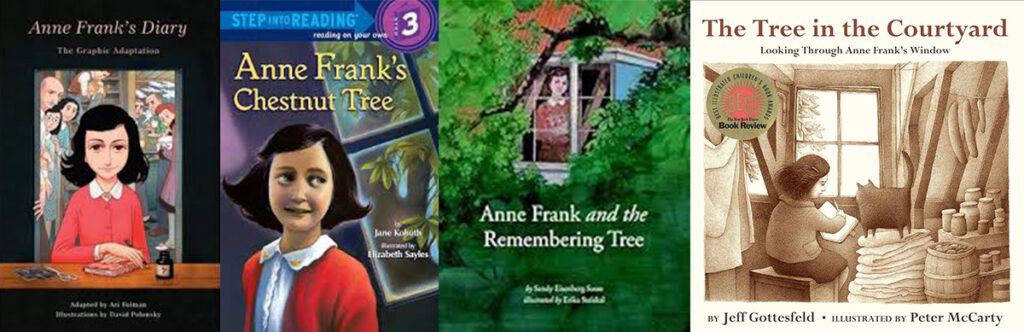
Related books:

Frank, Anne.  Numerous editions of The Diary and biographies at every reading and interest level, from picture book to newly independent reader to graphic format, and fully annotated.

Gottesfeld, Jeff. The Tree in the Courtyard: looking through Anne Frank’s window.

Kohuth, Jane. Anne Frank’s Chestnut Tree.

Sasso, Sandy Eisenberg. Anne Frank and the Remembering Tree.

Getting On the Wrong Train: The Last Hostage Home

Yesterday I got on the wrong train. No, that’s not right at all. I got on the right train, only then it went to the airport, so it was the wrong train after all. As the inimitable Kathryn Shultz has written with wonder: the thing about being wrong is it feels just like being right. I actually cried a little as I stepped off in Elizabeth, out of sheer frustration and perhaps exhaustion and stress too, knowing what the delay meant for the rest of my morning. I called a taxi. I hid from the cold inside the Colombian café across from the station, where no one spoke English and surely had far greater worries than I do right now. I bought pastries filled with guava. From the back seat of the taxi, I called the person I was meeting to tell him I wouldn’t make it after all. Hearing my distress, he asked if I’d taken a deep breath yet. I laughed. No, I hadn’t. Ironic. Hadn’t I just last week spent five days meditating in total silence with Buddhist monks, where all we did was focus on the breath? 

I was going to write something moving and beautiful about the return this week of Ran Gvili, z”l, the last person to come home from captivity by Hamas. I was going to write about the hair-raising coincidence that his body was brought back the same week that we read in the Torah, in parshat b’shallach, that 400 years after Joseph died, Moses remembered to take his bones out of Egypt and back to Israel with them for burial there. The rabbis wondered: how did Moses know where Joseph’s coffin was? They imagined the Egyptians had hidden the coffin as part of the strategy to prevent the Israelites from leaving. That Moses knew he couldn’t leave Joseph behind, and so he found Serach bat Asher, the mythically old lady who knew everything, and she told him to go to the edge of the Nile and call for the bones, for it was time to come home; and sure enough when he did, Joseph’s coffin rose to the surface from the depths of the Nile. Moses shouldered it, and so (Exodus 13) “Moses took with him the bones of Joseph, who had extracted an oath from the children of Israel saying: God will be sure to take notice of you, then you shall carry up my bones from here with you.” The IDF soldiers sang Hatikvah when they found Ran Gvili z”l’s body. 

But on the train, I read a beautiful piece by my colleague Rabbi Stuart Weinblatt, published here in the Times of Israel and pasted below, and so I decided to share that with you instead. Tomorrow at services – after our bar mitzvah boy leads us in the Song of the Sea that our ancestors sang as they crossed into miraculous, hope-filled redemption — we will say a collective mourner’s kaddish, joining the entire Jewish people in mourning not only Ran Gvili z”l, this week of his burial in Israel, but also the death of thousands: from those murdered on October 7, 2023 through all those killed in this brutal war, right up through the death this week of Sgt. Major Asael Babad z”l, 38-year-old father of 5, who was critically wounded in Gaza last October and died from his injuries this Thursday.

It turns out that we are often on the wrong train without knowing it, that it’s maybe the wrong train every time, and also the exact right one, too. Ran Gvili’s mother gave a beautiful eulogy, in which she said that she realized her mission is to prove we are one strong people, here to stay, and that we are all on the same side.

I gave the pastries to the taxi driver, who — like the bakery staff — didn’t speak English. The wrong train is the right train, we are all on it together, heading places of our own choosing and also sometimes where we never intended to go, where we never wanted to be. I took a breath, and another. The rest of my day was wonderful.


The Nation Turns Its Lonely Eyes To You: The Return of Ran Gvili

By Rabbi Stuart Weinblatt

The ordeal of the last hostage seized by Hamas and taken to Gaza more than 843 days ago came to an end this week with the return of the body of Ran Gvili and with his arrival at his final resting place today. It has not gone unnoticed that it coincides with this week’s Torah portion which tells us that “Moses took with him the bones of Joseph, (from Egypt) who had exacted an oath from the children of Israel, saying, “God will be sure to take notice of you: then you shall carry up my bones from here with you.”

The reception in Israel was one of mixed emotions—pleased that he was finally brought home to receive a proper burial, intertwined with sorrow and grief that it was his body, and not the living man that was returned, coupled with a sigh of relief that for the first time since 2014, there are no Israelis being held in Gaza by Hamas.

The roads carrying the 23-year old’s body to the cemetery where he was to be buried were lined with thousands of people who never met him. The nation paused to witness the funeral which was packed with hundreds of ordinary Israelis and the nation’s leaders.

Every Israeli knows his name. Everyone knows his story. Everyone felt a profound sense of relief that he was finally home.

As his mother said, “Our pride is much, much stronger than our pain.”

Moments like this are difficult for outsiders to fully grasp.

This is what it is like when a nation is a family—an extended family where, despite deep divisions and constant contention, and despite what many outsiders may not understand, there remains a shared sense of fate and destiny that ultimately overrides internal differences.

I think of the Simon and Garfunkel line, “Our nation turns its lonely eyes to you.” It captures the feeling in Israel. All eyes have been focused on the return of this hero, who, despite being injured, rushed to defend his fellow countrymen as soon as he learned they were under attack. He was as has been noted, “the first one in and the last one out.”

His courage and the outpouring from across the country reveal a kind of national intimacy that is rare in most other nations. It is a source of its strength and resilience, a distinguishing characteristic that makes Israel unique and which its enemies and detractors will never understand.

Reading Hints

We’ve turned the pages of our calendars to a new year. It’s winter with more time inside and more time to read.

We all know that reading can be instructive and relaxing, but reading has more benefits than just filling time.

Various research studies have come to the following conclusions about reading:

            1. According to a Yale University study, book readers live up to 20% longer than non-readers. Book readers have an advantage over magazine and newspaper readers, and fiction readers gain the most, suggesting that using one’s imagination might keep the mind active.

            2. Reading may slow memory loss in older people. One study found that reading was a protective factor for older adults of all educational levels.

            3. Reading can reduce stress and improve mental health. Reading fiction can have an immediate positive effect on mood and emotions. High schoolers who read stories were less stressed and anxious than non-readers.

            4. Because it is low energy and relaxing, reading can help with sleep. Some studies show that people who read hard copy books sleep better than those who don’t read.

            5. Reading boosts intelligence by exercising the brain.

Most American adults do not read enough. At least 23% of adult Americans read no books in over a twelve-month period. As with any new activity, start slowly; set a small, achievable reading goal. Reserve a time for reading just as you would reserve time to go to the gym. Find a comfortable spot to read or join a book club and make reading a social event. Finally, read something you like. Don’t make reading burdensome. You should look forward to your reading time.

Some suggestions for starting light are books by Daniel Silva or a classic like Up the Down Staircase. Many people like popular historical fiction, which combines lively storytelling with facts about an interesting person. Short stories are digestible and can usually be finished at one sitting. Even cookbooks like the ones by Joan Nathan make good reading.

In addition, look at what the young adult section has to offer. Even the children’s section has books that an adult will not find boring. Plotting in these books is strong; characters are well defined, and usually, the books are shorter than those in the adult section of the library. Don’t overlook the graphic novels, which have strong stories with great art.

Come into the library—public or synagogue—for suggestions. Librarians love to help readers find just the right book.

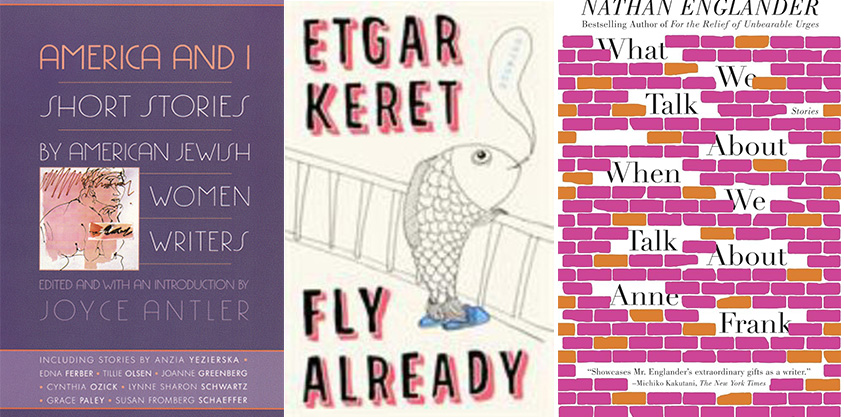
Here are some suggestions. Most can be found in our synagogue library; all are available at the public library.

Buchdahl, Angela. Heart of a Stranger is the autobiography of one of America’s most well-known rabbis.

Carner, Talia. The Boy with the Star Tattoo. Historical fiction, mystery, World War II, and a love story come together to make a quick read with a satisfying ending.

Finck, Liana. Let There Be Light; the real story of her creation. A new interpretation of Creation by a New Yorker cartoonist.

Geffen, Iddo. Mrs. Lilienblum’s Cloud Factory is a  comic novel about a tech startup that turns sand into rain clouds.

Gidwitz, Adam. Max in the Land of Lies. A World War II fantasy adventure. Anything by this author is good and also makes a good family read.

Kreitner, Richard. Fear No Pharaoh: American Jews, the Civil War, and the fight to end slavery. A serious but readable book.

Leegant, Joan. Displaced Persons: stories. The theme of these stories by an award-winning writer is displacement, home, and belonging.

On the Ninth Night of Hanukkah My Family Came to Me


When my husband Marc and I downsized about three years ago, we left behind the dining room table that fit 16, numerous pots and pans, tablecloths, and other accoutrements of hosting large groups. We thought that the days of entertaining large family gatherings were over, with no more deck and no more yard, and a large house to spread out in.

However, all the stars seemed to be aligned for a family Chanukah gathering with daughter Rebecca and her family coming from France to stay for a few days beginning on December 21st.

Oh, no!  They would not arrive until the evening. We’d have to celebrate on the ninth night of Chanukah.

I heartily advise improvising as we did. If Rebecca in France can celebrate Thanksgiving on the Saturday after its traditional date, we in Montclair can extend the spirit of Hanukkah to another night. Although we did not light an extra candle, we kept our electric menorah lit in the window, said shechecheyanu, and set up the latke bar.

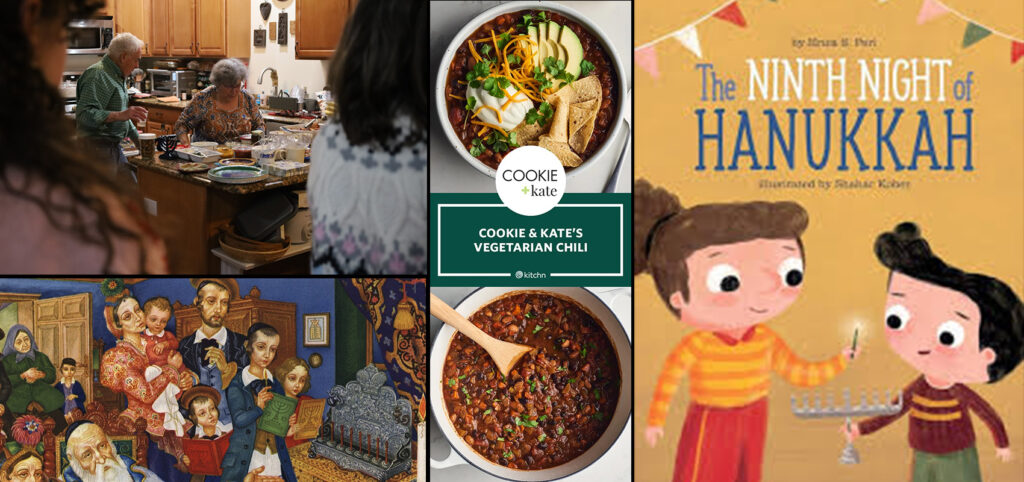
The invitation read “Please join us at the Latke Bar on Monday, December  22, about 6 pm to celebrate the 9th night of Chanukah and enjoy a visit between our American and French families.” The Latke Bar, of course, was the kitchen counter. However, we all had a good laugh when one of the New Jersey cousins confessed to thinking that Latke Bar was a local restaurant. She googled the name because there was no address in the invitation.

Hmm… might be a good idea for a pop-up next Chanukah.

The granite counter groaned under the weight of the latkes and their trimmings. We had traditional applesauce and sour cream (creme fraiche for a richer taste and Tofutti for our vegan cousin); brie and fig jam for those with a continental taste; pico de gallo, avocado and cheddar for those who wanted a Tex-Mex flare to their latkes; whitefish and lox, capers and cream cheese for the deli-delite crowd; sweet potato latkes and chutney for a more exotic taste;  mozzarella, basil and tomato for a taste of Italy, and a few extra toppings to complete the bar along with vegan chili.

For the cooks out there, a latke bar is a fairly easy way to entertain. Except for the latkes, most items are ready to serve as is, and your imagination and supply of small serving dishes are the only limitations.

Everyone had a wonderful time, clean up was easy, and we discovered that even without our large table, we could fit at least 14 people in our home and still have room not to trip over daughter Melanie’s dog, Maru.

In the end, it was the people, not the place, that made the holiday special.

Related book: Erica Perl. The Ninth Night of Hanukkah. When Max and Rachel can’t find their Hanukkah supplies in their new apartment, neighbors help with creative substitutes. They create a special ninth-night celebration to thank everyone.

Vegetarian/Vegan Chili     
Serves 4-6 generously

Chili is a very forgiving dish. Feel free to change the proportions of ingredients, add more spice, and play around with garnishes.

INGREDIENTS

2 Tablespoons olive oil
1 medium red onion, chopped
1 large red bell pepper, chopped
2 medium carrots, chopped
2 ribs celery, chopped
1/2 teaspoon salt, divided
4 cloves garlic, pressed or minced
2 Tablespoons chili powder or to taste
2 teaspoons ground cumin
1 1/2 teaspoons smoked paprika or to taste
1 teaspoon dried oregano
1-28 ounce can or 2-15 ounce cans diced tomatoes with their juice
2-15 ounce cans black beans, rinsed and drained
1-15 ounce can pinto beans , rinsed and drained
2 cups vegetable broth or water
1 bay leaf
2 tablespoons chopped fresh cilantro, plus more for garnishing
1-2 teaspoons sherry vinegar, red wine, or lime juice, to taste

Garnishes: chopped cilantro, sliced avocado, tortilla chips, sour cream or creme fraiche, grated cheddar cheese, etc., including vegan versions of sour cream and cheddar.

DIRECTIONS

  1. In a large pot over medium heat, warm the olive oil until shimmering. Add the chopped onion, bell pepper, carrot, celery and 1/4 teaspoon salt. Stir to combine and cook, stirring occasionally, until the vegetables are tender and the onion is translucent, about 7-10 minutes.
  2. Add garlic, chili powder, cumin, smoked paprika, and oregano. Cook until fragrant, stirring constantly, about 1 minutes.
  3. Add the diced tomatoes and their juice, the drained beans, vegetable broth and bay leaf. Stir to combine and bring to a simmer. Continue cooking uncovered, stirring occasionally and reducing heat as necessary to maintain a gentle simmer, for 30 minutes.
  4. (optional) Remove chili from the heat and discard bay leaf. Transfer 1 1/2 cup of chili to a blender, making sure to get some of the liquid portion. Blend until smooth (watch out for hot steam), then pour blended mixture back into the pot.  Or blend briefly with an immersion blender or mash with a potato masher until it thickens.
  5. Remove bay leaves if not done already. Add cilantro. Stir to combine and then mix in vinegar or lime juice to taste. Add salt to taste.
  6. Serve in bowls with garnish of choice.

NOTE: If possible make a day ahead for best flavor. Holds in refrigerator for 4 days and can be frozen.

Adapted from Cookie and Kate Homemade Vegetarian Chili

Why We Light the Lights Tonight – A Chanukah Message in the Wake of the Australia Attack

I was all set to send out a sweet message of hope, of kindling light in the darkness, adding light to the world, all that good-vibes Chanukah stuff. But now, before the earth has rotated around enough for us to be kindling our first lights, we are reeling from the news from another hemisphere. This time from Australia; but it is of a piece, isn’t it, with my having to announce from the bimah on Yom Kippur the murder of Jews in England? Our hearts are with all of the families and the communities grieving right now. We grieve with them… and we fear, for ourselves.

And so our Chanukah lights this year are about more than the very beautiful idea of making the world a little brighter at the darkest of seasons. I think as we light tonight, we can focus on something else, too: our sense of solidarity with the Jewish people. As journalist Ezra Klein wrote in his 2019 book Why We’re Polarized, “The simplest way to activate someone’s identity is to threaten it.” In fact, as he goes on to explore and brings the studies to prove, a threat to one’s identity can seemingly awaken even one’s dormant identities.

There are lots of reasons to light Chanukah candles starting tonight. Yes, they will remind us to hope and work for light in even the darkest of moods and times. Yes, they will help us pause to gather with loved ones to light or to wish one another a chag sameach, a happy holiday. Yes, it is a mitzvah. But tonight we double down on something else: that lighting the Chanukah lights is an act of solidarity with the Jewish people. We light to recall other generations in which Jewish life has been under threat, and we light because none of that has ever stopped Am Yisrael Chai, the Jewish people as a living, thriving being. That no matter what happens, no matter how dormant our identities at other times, right now we are awake and ready to keep the flames of the Jewish story burning bright.

This week, we recite the al hanissim prayer after lighting the Chanukah candles and at other times throughout the week. It recounts the Chanukah story and thanks God “for the miracles and wonders and mighty deeds and salvations and victories You wrought for our ancestors in their days and in this day.” Rabbis have long remarked on that final clause, “and in this day.” How can we know that every year that clause will be true? Because when we stand together as a people reciting our ancient words and performing our sacred rituals, we feel the miracle unfolding right here. The miracle is us. That will carry us through this week, this year, and always.

Chag urim sameach – may it be a holiday of light and joy.

Remarks at the Oheb Shalom Fall Fundraiser, December 6, 2025

Recognizing that everyone is entitled to my opinion, here are my thoughts for tonight.

I think that doing the right thing and knowing when and how to do it is a key part of a happy and successful life.

So now a little d’var about growing old and making correct choices.

In the book Ecclesiastes, Chapter 3, there is one of the greatest poems about timing and choices ever written. We all have heard it many times. It starts, “for everything there is a season, a time for everything under the sun.”

As I approach my  95th birthday, with apologies to King Solomon, I realize that for me, too, there is a time for everything, a season for everything that occurs with and to me.

A time for trying to do it all and a time to get help.

A time to live through others and a time to be yourself.

A time to say yes and a time to say no.

A time to run and a time to nap.

A time to honor and a time to be honored.

A time to believe and a time to challenge.

A time to worry more and a time to worry less.

A time to kiss and a time to just shake hands.

A time to talk and a time to listen.

A time to join in and a time to sit back and watch.

A time to pay close attention and a time to doze off.

A time to be always right and a time to realize how little you really know.

A time to hide and a time to come out.

A time to be humble and a time to be proud.

A time to be optimistic and a time to be realistic.

A time to show up and a time to stay away.

A time to hire a consultant and a time to just pay attention to what’s going on.

A time to fight and a time to give in.

A time to cook and a time to eat out.

A time to plant and a time to let anything grow there that wants to grow there.

A time to dress up and a time to dress down.

A time to walk and a time to ride.

A time to try to look forever young and a time to embrace your age.

A time to shave and a time to let it grow.

A time to stand up and a time to sit down.

A time to fish and a time to cut bait.

A time to let chaos in and a time to lock the door.

A time to sew and a time to buy new.

A time to try to get more and a time to stop accumulating.

A time to press on and a time to back off.

A time to join in and a time to sit back and watch.

And everlastingly, through all generations, there is always a time for shalom bayit… a time for peace in the house.

So now, my paraphrasing is finished. There is a time to start and a time to stop.

In the end, here is probably the single best time of all for each of us to make a time to be yourself. Everyone else is taken, anyway.

I conclude now with a hope and a prayer:

My hope is that Oheb continues to flourish and grow from strength to strength in all that we do.

My prayer is that in be granted a little more time to see it happen, in good health and growing inner peace.

Thank you for honoring me.

G-d bless you all.

And bless me also.

Jewish Book Month


The month leading up to Hanukkah is Jewish Book Month. This year, it began on November 15 and runs until the first night of Chanukah, December 14. Since 2025 marks the 100th anniversary of this celebration of Jewish books, the Jewish Book Council has done much to enhance the celebration.

Take a look at this list of the hallmark fiction books of the last 10 decades. How many have you read?

Jewish Book Week began in Boston when Fanny Goldstein, a Jewish librarian at the Boston Public Library decided to display Jewish books to showcase the Jewish culture of many of its branch library’s patrons. By 1940, the week morphed into a month, and the celebration was moved permanently to Hanukkah by 1943.

Fanny was not one note, however. Because she believed in exposing her patrons to other cultures, Fanny created displays about other groups who visited her library. In addition, as she rose through the library ranks and became better known, she spoke frequently on politics and social issues.

During World War II, Goldstein’s committee evolved into the Jewish Book Council, which sponsors this major celebration of Jewish books and authors. Visit the JBC site for more about Jewish Book Month, including a display of the beautiful posters created by some of the most well-known Jewish artists and illustrators, reviews of new books, interviews with authors, and essays about authors and books.

For more information on this remarkable, far-sighted, and open-minded woman, read Richard Michelson’s biography, Fanny’s Big Idea: How Jewish Book Week Was Born, or follow this link.

And come into our library to browse the shelves, which hold many treasures of Jewish literature.

Thanksgiving: Letting in the Light

This morning as I handed Eloise a plate of pancakes—because sometimes I actually do have my act together early and pancakes on school days can happen, and actually they were oladushki, which as all y’all from the FSU will know are cooked in oil not butter, which makes them perfect for this month of Chanukah, but none of this is the point—the point is that as I set her breakfast down at 6:45 am, she looked at me and said, “Mommy, did you see the sunrise?”

I had not, because while nice weekday breakfasts do sometimes happen, they involve stumbling around in the dark pretending the day has not truly begun, so no, I hadn’t opened the shades or looked outside yet. Turns out it was a gorgeous pink-sky morning, and I’d missed it.

‘Tis the season, dark at breakfast and at dinner again, too. We feel the creeping darkness in our moods as we inch toward the solstice. But more than that—symbolically—isn’t this right on, the way we constitutionally avoid brightness of many kinds, at all seasons, missing what is beautiful and shimmering just beyond the edges of our awareness as we choose the dark and depressing instead? This is what the Sefat Emet and other rabbis noted about this month of Kislev we are now in, at the end of which—around the solstice—we begin lighting the Chanukkah candles. The darkness this month forces us to look for what is concealed rather than what is obvious, to light extra lights. Time to lift up those blinds and see the hidden glory behind.

Which brings me to Thanksgiving. Our National Mood Disorder has us all exhibiting a variety of symptoms. The list is long and I won’t get into it here. All I’ll say is that it can feel hard to see that there is light here with us, too.

According to the Smithsonian, “festivals of Thanksgiving were observed sporadically on a local level for more than 150 years.” The first Thanksgiving celebrations were summer affairs, giving thanks for rain after a drought and related light-out-of-darkness agricultural moments. In 1789, Elias Boudinot, representing New Jersey in the House of Representatives, moved that a national day of Thanksgiving be held to thank God for giving the American people the opportunity to create a Constitution to preserve their hard-won freedoms. After a Joint Committee approved the motion, President George Washington proclaimed that the people of the United States would observe “a day of public thanksgiving and prayer” on Thursday, November 26. It didn’t catch on, however, for another 150 years, with some (like Thomas Jefferson) objecting on the grounds that it violated separation of church and state. But get this:

“Most of the credit for the establishment of an annual Thanksgiving holiday may be given to Sarah Josepha Hale. Editor of Ladies Magazine and Godey’s Lady’s Book, she began to agitate for such a day in 1827 by printing articles in the magazines. She also published stories and recipes, and wrote scores of letters to governors, senators, and presidents. After 36 years of crusading, she won her battle. On October 3, 1863, buoyed by the Union victory at Gettysburg, President Lincoln proclaimed that November 26, would be a national Thanksgiving Day, to be observed every year on the fourth Thursday of November.”

Note that wonderful 36, double chai, tucked in there. Sometimes beautiful traditions are hidden and take a long time to see the light. And maybe that’s part of the wisdom of this week’s parasha, too, because the Joseph story we begin reading now is as much about what is concealed as what is revealed. Joseph enters the world in this week’s parashah, and from the start nothing about him is straightforward. His dreams will be misunderstood, his identity buried again and again, his gifts and God’s hand invisible until they are brought to light.

Thanksgiving gives us a national moment that mirrors this spiritual lesson. Giving thanks is the practice of noticing what we otherwise overlook, taking stock not only of the things that shine brightly but of the extraordinary that live concealed by the everyday. In a season of darkness—literal and metaphorical—Thanksgiving offers us a chance to pause and try to name the small goodnesses that would otherwise go unnoticed. In that way, it aligns with Kislev’s invitation: Lift the blinds. Light the candles. Let the hidden colors and light in.

And because gratitude is a practice, not just a feeling, I want to offer two simple takeaways for this week.

First: bless your food at the Thanksgiving table. In Jewish life, we go granular, giving thanks not just for the category “food” but for exactly what we are blessed to have on our plates. If the main centerpiece is the turkey, then recite this one—which is one of my favorite blessings in the entire canon:

בָּרוּךְ אַתָּה ה׳ אֱלֹהֵינוּ מֶלֶךְ הָעוֹלָם שֶׁהַכֹּל נִהְיָה בִּדְבָרוֹ.

Barukh attah Adonai eloheinu melekh ha-olam, she-ha-kol nihyeh bi-d’varo.

Praised are You, Lord our God, Sovereign of the Universe, at whose word all things come into being. For a full directory of food blessings (it’s not always hamotzi, that’s the point!) click here.

Second: join our Gratitude Circle, back by popular demand (or maybe just rabbinic whim) for year two. A WhatsApp group we’re opening this week for you and anyone in your life who wants to join in. Every day from Thanksgiving through the end of Chanukah (December 22) we will each post one thing we are grateful for. No cross-talk, no politics, no commenting besides an emoji, just a running list of things we are grateful for. Think of it like adding one more candle each night. Each person offering one small spark from their day, the light building as we share it with one another.

During this month of searching for light in the dark, I hope this is how we will find it: together noticing, naming, sharing goodness and gratitude, to reveal what is already here but too often hidden from view. Happy Thanksgiving, may our giving thanks be part of the way from darkness to light.

Gratitude


At this time in our secular year, we are supposed to be thankful. Of course, we should be thankful all year round. Our Jewish tradition has almost endless ways to say thank you.

The book that I’d like to bring to your attention is not a specifically Jewish book, but its premise of thankfulness is very Jewish.

A.J. Jacobs has made a literary career of immersing himself in a topic: he’s spent a year living Biblically, which he describes in The Year of Living Biblically: One Man’s Humble Quest to Follow the Bible as Literally as Possible. He has attempted to live as the Founding Fathers did, which he writes about in The Year of Living Constitutionally: One Man’s Humble Quest to Follow the Constitution’s Original Meaning.  He’s tried to become a know-it-all by reading his way through an entire encyclopedia in The Know-It-All: One Man’s Humble Quest to Become the Smartest Person in the World.

In 2018, inspired by a conversation with his then 10-year-old son, he decided to be thankful, and in Thanks a Thousand: A Gratitude Journey sets out to thank everyone associated with the cup of coffee purchased at Joe Coffee, his local coffee shop.

From the owner of the shop to the manufacturer of the cup to the farmers and distributors, Jacobs discovers how intricate the world of the simplest thing is. It is almost overwhelming but also illuminating as the reader realizes how interconnected our world and its bounty are. Jacobs says,” If we connected the world with threads signifying gratitude, the result would be as thick as a blanket.”

How grateful people are to be noticed and thanked.

You may not want to rush to the nearest coffee bar to say thank you, but as we approach Thanksgiving, you might be inspired to be more appreciative of whoever puts food on the table in your home.

As Rabbi Nachman of Breslov taught, giving thanks for even the smallest thing is important. For him, gratitude was a path to joy and connection with God.